Short answer: Google is making website links more visible in AI Mode and AI Overviews, and is testing a section that shows official sources near the top of some answers. For businesses, it is a good moment to review the essential information on your site and whether Google can reach it. The announcement does not say these changes will bring more traffic to any individual site.
Based on Google’s Search blog and Google Search Central documentation, checked on 26 October 2026.
What did Google change in AI Mode and AI Overviews?
Google announced five changes that put links to websites more visibly inside AI answers. They are described in the October 15, 2026 post More ways to connect with the web from Search:
- More inline links, the links placed on words or phrases inside an AI response, shown higher in responses more often.
- A test of an official websites section at the top of some responses, with context on why each link is useful.
- News carousels of timely articles in more locations and languages, highlighting the reader’s Preferred Sources.
- Related article links at the end of some responses, now with image thumbnails.
- A test of clickable creator and publisher names on video results in AI Mode, leading to their Search profiles.
The official websites section and clickable creator names are tests. Google has not published a rollout schedule or a list of supported countries for those tests.
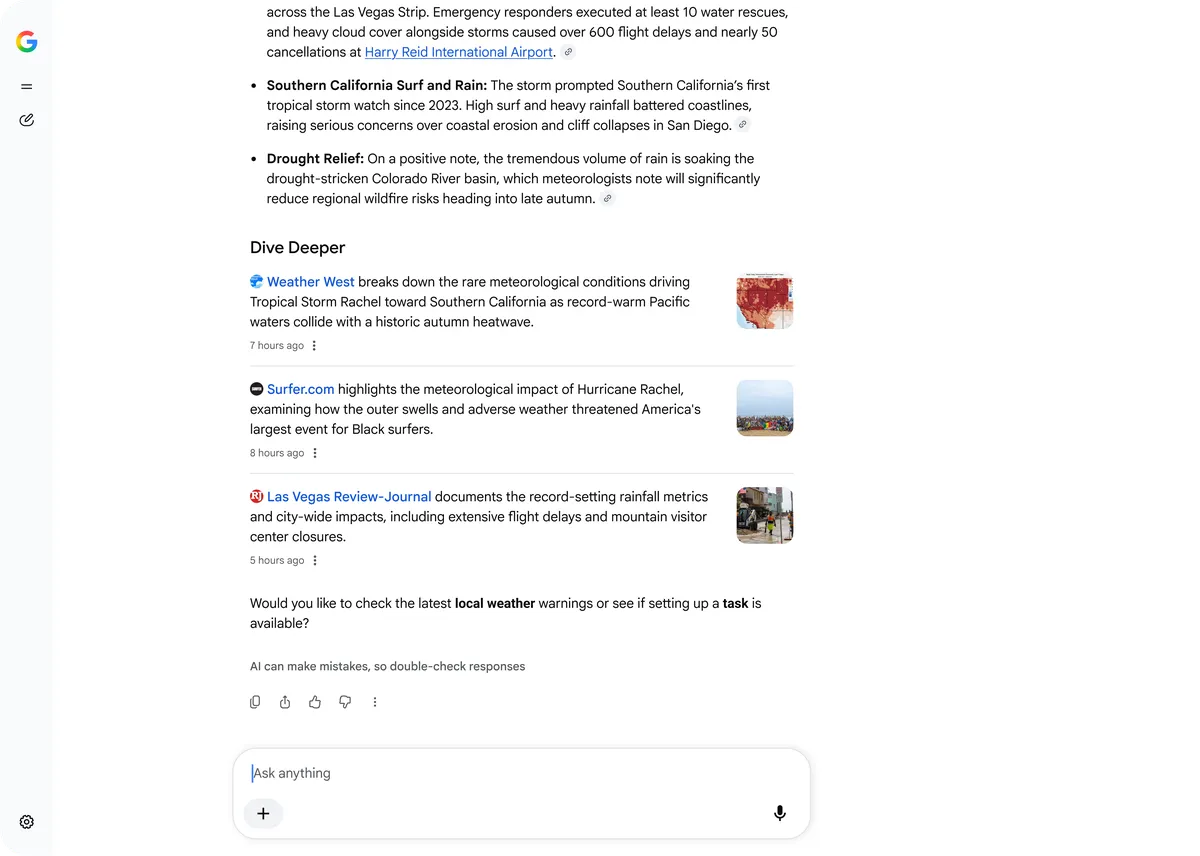
What is the official websites test, exactly?
It is narrower than “a place for every company’s website”. Google frames it around situations where there are only one or two official places on the web to complete a specific task or get exact information, and says it will test surfacing those links in a dedicated section at the top of a response.
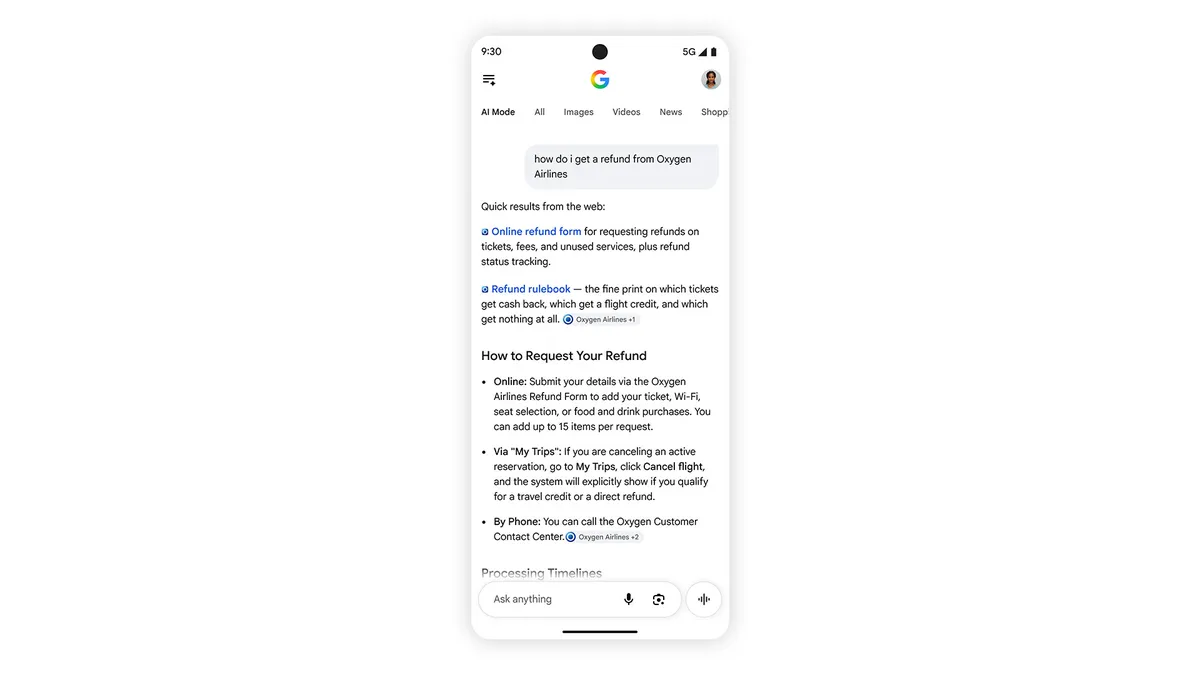
Google’s illustration uses an airline refund request: links to the refund form and rules appear before the longer explanation. Google has not published how it decides which site is official. Our interpretation is that the test is particularly relevant when a person needs a specific destination to complete a task. It does not establish a general advantage for every business website on broad research questions.
Google’s site names documentation recommends WebSite structured data on the home page as the main way to state your preferred site name. That is good practice for how your name appears in Search. Google has published no link between it and the new test, so treat it as housekeeping, not as a way in.
Will more visible links bring more traffic to my site?
Not necessarily. More prominent links create more chances for a click, but Google’s post gives no figures on clicks to websites, and nothing in it promises traffic to a particular site. Whether people click still depends on whether your page is the one that completes their task.
Measuring this is also harder than it looks. Google’s guide to AI features and your website says traffic from AI Overviews and AI Mode is included in the Search Console Performance report under the Web search type, together with the rest of your Google traffic. The report does not separate it out, so a rise or fall there cannot be attributed to this update on its own.
What should most business websites do first?
Start with the pages that do the job a searcher came for, not with new content. For most service and product businesses that means the pages that explain what you offer, for whom, how it works, what is not included and how to get started. Adding more general articles about AI will not make up for a service page that leaves those questions open.
Then check that Google can reach those pages. The AI features guide says a page must be indexed and eligible to show with a snippet, that there are no additional technical requirements and that no special schema.org markup is needed. It also says meeting the requirements does not guarantee that a page is indexed or shown, and that Search policies still apply.
A hypothetical example: a vague service page
Imagine a company that offers IT support to small offices. Its service page says it delivers “tailored, reliable IT solutions for your business”, lists a few icons and ends with a contact button. A visitor, or a search system, cannot tell from it which services are included, whether the company works on site or remotely, which areas it covers or what happens after the first call.
When we restructure a page like this, we start with a page outline of the questions the page must answer, in the order a buyer asks them: what is covered, who it is for, how onboarding works, what is outside the scope, how to start. Each answer becomes a short, clearly headed section on the same page. A visitor gets the facts they need to decide, and the page now contains specific, linkable answers instead of a slogan.
The example does not split every question into its own page. A separate page makes sense only when a question deserves a full answer of its own, such as a distinct service.
Who else should pay attention to this update?
The rest of the update matters mainly to two smaller groups, in this order.
Businesses that publish regularly. If you run a blog, news or guides, Preferred Sources are relevant. A signed in user can choose your site, and it is then more likely to appear in Top Stories with a preferred badge, and can get the same badge in AI Mode and AI Overviews. Only domains and subdomains are eligible, not subdirectories. Google offers a button and a deeplink to invite readers, and brought Preferred Sources to AI search in May.
Creators and brands with a large social following. Search profiles collect a creator’s or publisher’s content on Google Search. According to the Search profiles help page, they currently require at least 10,000 followers on YouTube, Instagram, X or TikTok and are available in Canada, India and the United States. For a business outside those countries, or without that audience, this part has no immediate use.
What should you do now?
Choose the actions that apply to your business before working through the checklist.
| Website or audience | First priority | What to keep in mind |
|---|---|---|
| Service or product business | Make key service, product and contact pages useful and accessible to Google. | The announcement does not guarantee inclusion or more traffic. |
| Business publishing news or guides regularly | Check whether readers can select the domain as a Preferred Source. | This is a reader preference, not a ranking boost for everyone. |
| Creator or brand meeting the Search profile requirements | Check for an existing profile before creating or claiming one. | Country and follower requirements apply. |
For most business websites, work through these checks in order:
- Review your key task pages. Service, product, contact and booking pages should answer what, for whom, how, what is excluded and how to start.
- Check indexing. In Search Console, confirm those pages are indexed and not blocked by
noindexor snippet controls you did not intend. - Tidy your site identity. Add or check
WebSitestructured data and keep your name consistent in titles and headings, as general good practice. - Avoid unnecessary new pages. Create a separate page when a topic needs a substantial answer that does not fit naturally on an existing page.
- If you publish regularly, add Google’s Preferred Sources button or deeplink to your articles.
- If you are eligible, claim your Search profile.
- Measure with care. Watch your key pages in Search Console over a longer period, and do not read a short term change as the effect of this update.
For the broader picture of earning citations in AI search, see our guide on how to get cited by ChatGPT, Perplexity and AI Overviews.
If your key service pages need to explain your offer more clearly, planning page structure and content is part of our web design work. Tell us about your site and the pages that matter most to your business.